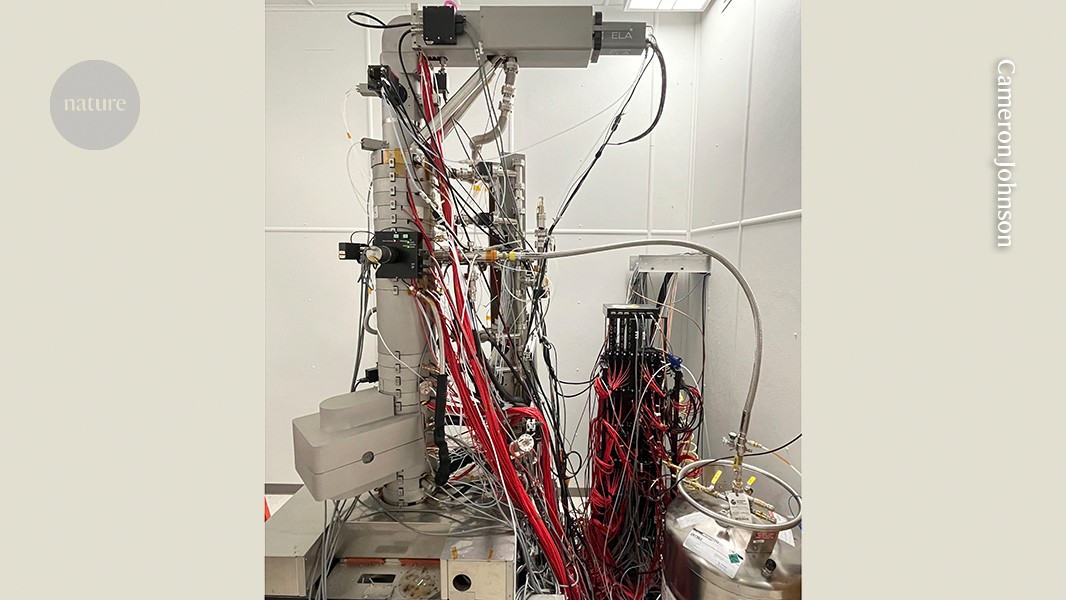
When it comes to imaging materials, the colder the sample is, the better. At room temperature, atoms hum with thermal energy and appear blurry in images, but at ultra-cold temperatures, near absolute zero (0 kelvin), they come almost to a standstill. Now, a team of researchers has built a microscope that operates at these extreme temperatures, achieving images of unprecedented clarity and opening a new pathway into the quantum world.
The instrument, described in a recent paper in Nature, uses a cryogenic cooling system to chill its sample and its detection apparatus to just a few millikelvin above absolute zero. At such temperatures, the usual thermal vibrations that blur atomic-scale images are dramatically suppressed, allowing researchers to see the true electronic and magnetic structure of a material without the 'noise' of heat.
'We are essentially turning down the volume of the thermal background,' said lead researcher Dr. Maria Chen, a condensed matter physicist at the University of Cambridge. 'At room temperature, the atoms are constantly vibrating, which smears out the features we want to study. By cooling to near absolute zero, we can see the intrinsic properties of the material itself.'
The microscope achieved resolutions below 0.1 nanometers while maintaining a sample temperature of 10 millikelvin. This represents a roughly tenfold improvement in clarity over the best room-temperature scanning tunneling microscopes, the current workhorse for atomic-scale imaging. The team demonstrated the instrument by imaging a high-temperature superconducting cuprate, revealing fine details of the charge density waves that are thought to play a role in the material's ability to conduct electricity with zero resistance.
'Being able to see these patterns at such resolution could help us understand the mechanism of superconductivity better,' Chen explained. 'If we understand how the electrons organize themselves, we might be able to design materials that superconduct at higher temperatures, potentially even room temperature one day.'
The implications extend beyond superconductivity. Many quantum materials — including topological insulators, quantum spin liquids, and certain kinds of magnets — exhibit phases that are only accessible when thermal energy is minimized. By providing a tool that can image these materials at their quantum limit, the microscope could accelerate the discovery of new states of matter and novel quantum phenomena.
'This is not just an incremental improvement,' said Dr. Jonathon Kim, a quantum materials scientist at MIT who was not involved in the study. 'It's a new capability. For the first time, we can directly image quantum materials in the regime where quantum effects dominate, rather than being washed out by heat.'
The technology required significant engineering ingenuity. Traditional microscopes rely on room-temperature detectors and room-temperature electronics, both of which generate heat that would undermine the cooling effort. The Cambridge team developed a novel system of superconducting nanowires as detectors and a multi-stage magnetic shielding scheme to isolate the instrument from Earth's magnetic field, which can also interfere with quantum measurements.
The microscope is currently a prototype, about the size of a large refrigerator, and requires specialized infrastructure to maintain the ultra-cold environment. The researchers are now working on a compact, user-friendly version that could be deployed in more laboratories. Even in its current form, however, it has already attracted interest from several major research institutions.
'This could be a game-changer for the field,' Kim added. 'If the technology can be scaled and made more accessible, it could become as essential to quantum materials research as the electron microscope was to chemistry and biology in the 20th century.'
The research was funded by the UK Engineering and Physical Sciences Research Council and the European Research Council. The team plans to make the microscope available to the broader scientific community later this year through a series of access programs at the Cavendish Laboratory.
'We're at the very beginning of what this could enable,' Chen said. 'But the fact that we can now look at these materials without the thermal blur is, I think, going to change the way we think about quantum matter.'
The paper, titled 'Cryogenic scanning probe microscopy at the quantum limit,' is available now in Nature.