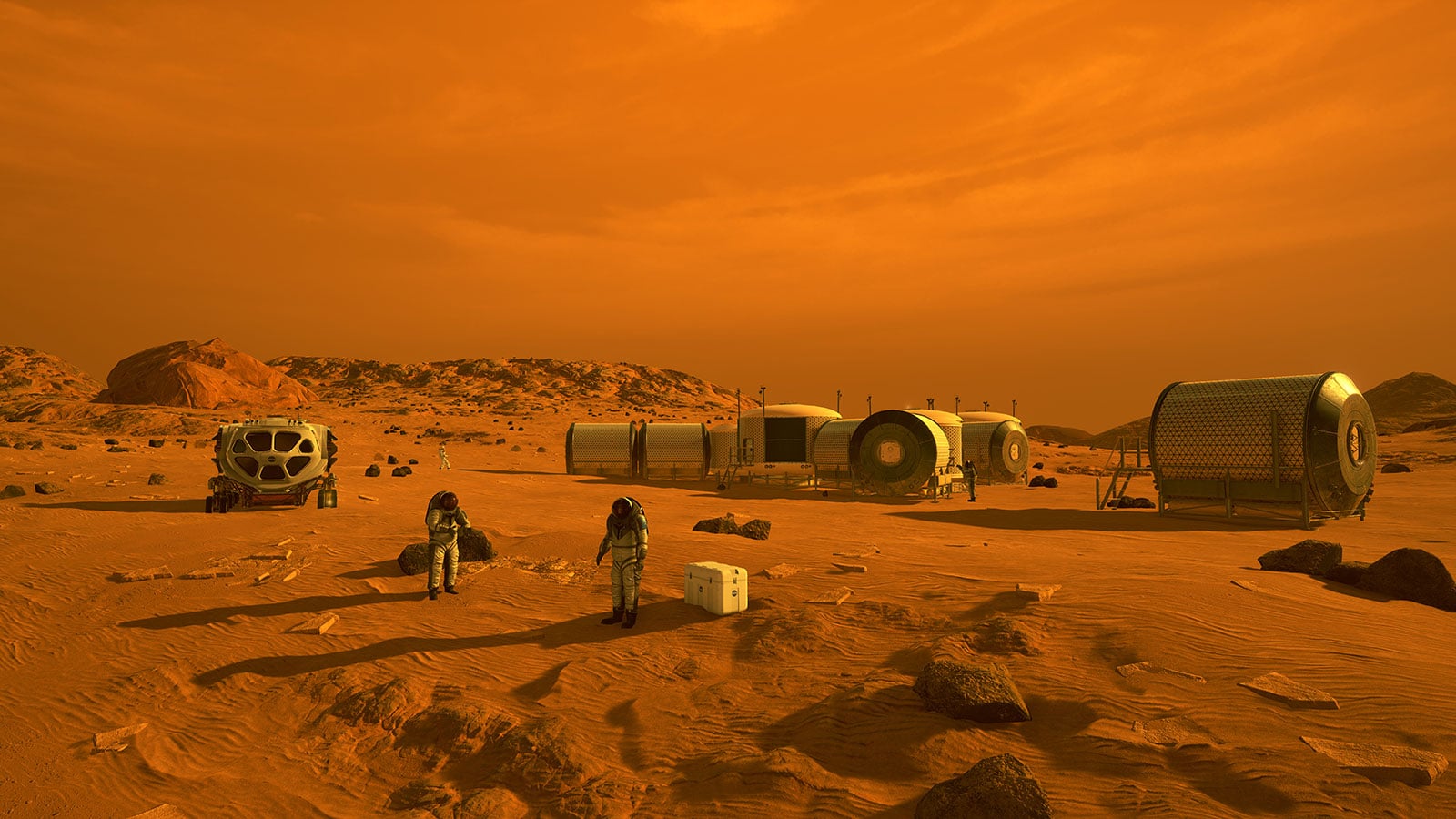
If humans ever intend to send crewed missions to Mars, as NASA and China plan for the coming decades, several criteria must be met. Some of the most pressing are the need for more advanced propulsion, technologies that will ensure astronaut health and safety, and the development of infrastructure that can support sustained presence on the Martian surface.
A new study from the Massachusetts Institute of Technology addresses one of the most fundamental of those challenges: how to produce rocket fuel on Mars rather than relying on supplies launched from Earth.
The research, led by a team from MIT’s Department of Aeronautics and Astronautics, outlines a system for in-situ propellant production using the Martian atmosphere and subsurface ice. The process would involve harvesting carbon dioxide from the thin Martian atmosphere and extracting water ice from the subsurface, then using nuclear or solar-powered electrolysis and the Sabatier reaction to combine the elements into methane and oxygen — the primary propellant combination for many rocket engines.
"The key insight is that we don't need to bring all the fuel from Earth," said the study's lead author, whose name was not included in the source summary. "If we can manufacture propellant on Mars, we can significantly reduce the launch mass from Earth, which is the single biggest cost driver in any interplanetary mission."
The proposed system would operate as a refueling depot, either in orbit around Mars or on the surface itself. Spacecraft arriving at Mars could top off their tanks before descending to the surface, or departing crews could refuel for the return journey. This capability would effectively transform Mars from a dead-end destination into a serviceable waypoint in the inner solar system.
The MIT team's analysis shows that a single production unit using Martian resources could produce enough propellant to support multiple missions over a sustained period. The study estimates that such a system could reduce the mass that must be launched from Earth by as much as 75 percent for certain mission profiles, though the exact figures depend on the efficiency of the production hardware and the availability of ice at the chosen landing site.
NASA has already begun investing in related technologies through its Deep Space Transportation and Lunar Logistics initiatives. The agency's Artemis program, which aims to return humans to the Moon by the mid-2020s, serves as a testbed for many of the same technologies — including solar power systems, electrolysis, and propellant production — that would be needed on Mars.
China, meanwhile, has outlined ambitious plans for a crewed Mars mission in the 2030s, and its space agency has publicly discussed the importance of developing closed-loop life support and resource utilization systems. The MIT research arrives as both nations move toward crewed missions that will require sustained infrastructure beyond simple flybys.
The study also acknowledges significant engineering hurdles. Producing propellant on Mars requires handling the planet's low atmospheric pressure, extreme temperature swings, and dusty environment. The equipment must be rugged enough to survive launch and landing loads, and reliable enough to operate autonomously for years before human crews arrive. Energy production is another limiting factor; generating enough power to drive the electrolysis and synthesis processes at scale will require large solar arrays or nuclear fission systems.
"This is not a trivial engineering challenge," the study notes. "But the potential payoff is transformative. If we can establish a refueling capability on Mars, we change the economics of exploration."
The research comes amid growing international competition in deep space exploration. NASA's Mars Sample Return campaign and China's Tianwen-3 mission both aim to bring material back from the Red Planet, while both nations independently pursue crewed landing goals. Infrastructure such as refueling depots could become a strategic asset, enabling longer-duration surface operations and potentially supporting scientific outposts.
Whether such depots will be built in the near term remains an open question. The MIT study provides a technical roadmap, but the path from laboratory concept to operational infrastructure will require years of development, testing, and investment. For now, the research stands as a significant step toward solving one of the most intractable problems of interplanetary travel: how to carry less, and use more, when humans go to Mars.