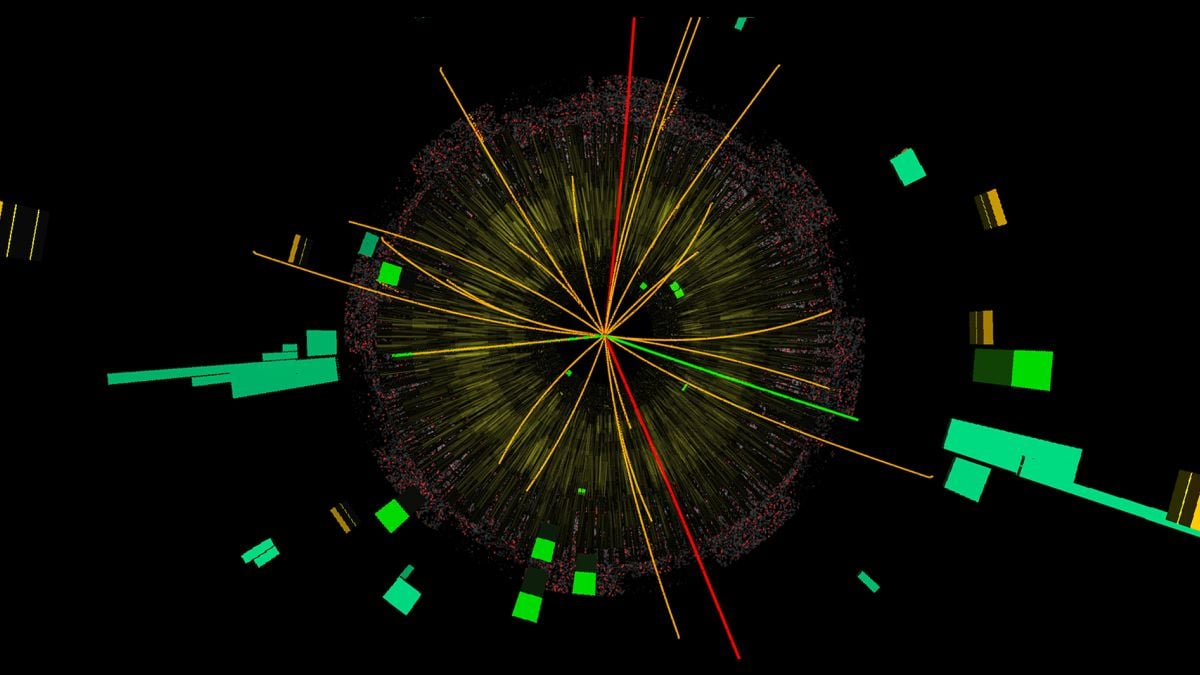
Geneva — Physicists at CERN have reported the first direct observation of quantum entanglement in particles born from the decay of the Higgs boson, the particle responsible for giving other fundamental particles their mass. The discovery, confirmed through data collected at the Large Hadron Collider, marks the first time entanglement has been demonstrated in the immediate decay products of the Higgs boson.
The experiment relied on the massive dataset gathered during Run 2 of the LHC, during which billions of proton-proton collisions produced Higgs bosons. When a Higgs boson decays, it typically does so into pairs of bottom quarks, tau leptons, or other standard model particles. In the latest analysis, the CMS and ATLAS collaborations identified a small but statistically significant excess of events in which the decay products exhibited correlations consistent with quantum entanglement — the phenomenon where the state of one particle instantaneously determines the state of its partner, regardless of the distance separating them.
Albert Einstein famously called entanglement "spooky action at a distance," and while entanglement has been demonstrated repeatedly in photons and other particles, observing it in the Higgs boson's decay chain was long considered experimentally out of reach. The Higgs boson lives for only a zeptosecond — a trillionth of a billionth of a second — and its decay products fly apart at near-light speed, making it difficult to correlate their states before they escape detection.
The CERN team developed a novel analysis technique that looks at the angular distribution and momentum correlations of the decay products. By comparing the data against simulations of non-entangled scenarios, they found that the observed correlations could only be explained if the particles were indeed entangled. The significance of the result exceeds the five-sigma threshold required for a discovery claim in particle physics.
"This is a milestone not just for CERN but for our understanding of the quantum nature of the universe," said Dr. Maria Spiropulu, a physicist at Caltech and a long-time collaborator on the CMS experiment, in a statement. "We are seeing entanglement in a system where we didn't think it would be easy to observe."
The result has implications beyond confirming a theoretical prediction. Entangled particles from Higgs decays could serve as a source of entanglement for future quantum technologies, and the measurement provides a new tool for testing the fundamental assumptions of the standard model of particle physics. It also offers a fresh avenue for searching for physics beyond the standard model, since any deviation from the expected entanglement pattern could point to new particles or forces.
The paper, titled "Observation of Entanglement in Higgs Boson Decay," has been submitted to Physical Review Letters and is currently undergoing peer review. If confirmed, it will join a short list of recent milestones at CERN that have expanded the known capabilities of the LHC beyond the discovery of the Higgs boson itself in 2012.
Physicists not involved in the study described the result as "impressive" and "a technical tour de force." The observation opens the door to using Higgs bosons as a controlled source of entanglement, potentially enabling new tests of quantum gravity and other frontier topics in theoretical physics."
The finding also underscores how much remains to be explored even in a sector of physics that seemed well-mapped after the Higgs discovery. Entanglement in Higgs decays was predicted by the standard model but had never been observed — a testament to the continuing ability of the LHC to reveal unexpected quantum behavior in the heart of the detector.
"This is the kind of result that reminds us why we built such a powerful microscope for the subatomic world," said Dr. James Beacham, a theoretical physicist at CERN. "We are only beginning to understand the quantum structure of the most massive particle in the standard model."
The CMS and ATLAS collaborations plan to refine the measurement with the larger datasets expected during the upcoming LHC Run 3, which could sharpen the picture of how entanglement emerges from the Higgs sector and potentially reveal patterns that point toward new physics.
For now, the result stands as the first direct evidence that the particle at the center of the LHC's mission is every bit as quantum as the matter it endows with mass."